
Hardware

Product Types Choosing

Hardware ProductsHigh‑resolution mass spectrometerGlow Discharge Mass SpectrometerGD90 Trace-RF High-Resolution Glow Discharge Mass Spectrometer

GD90 Trace-RF High-Resolution Glow Discharge Mass Spectrometer

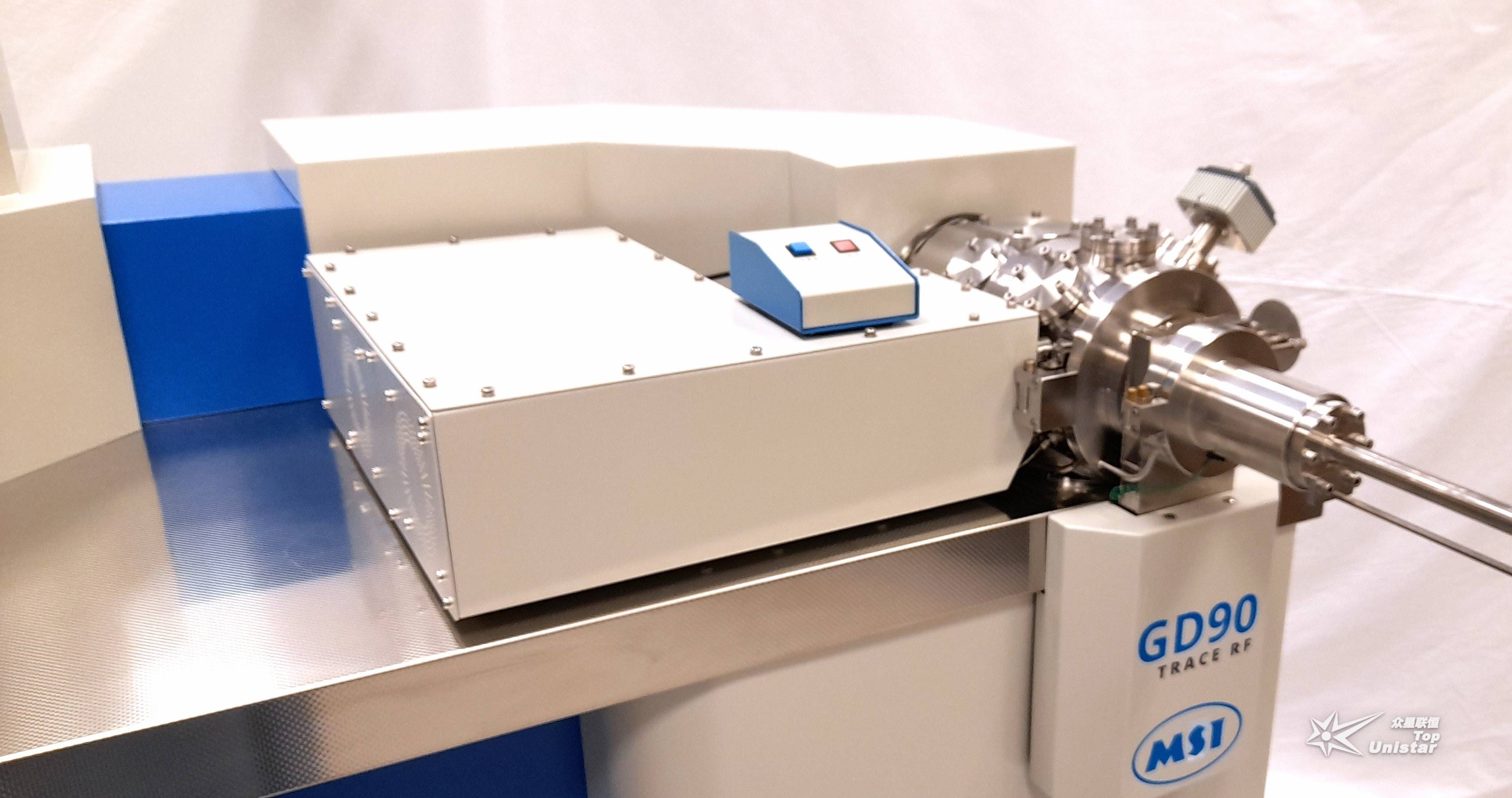
The MSI GD90 Trace-RF is a high-resolution glow discharge mass spectrometer for direct elemental analysis of solid materials. Its double-focusing magnetic-sector analyser combines established DC glow discharge with automated RF excitation for a wider range of conductive and non-conductive samples. It covers major constituents to ultra-trace impurities and supports depth profiling of films, coatings and multilayer materials.

GDMS

Model: GD90 Trace-RF
Brand: MSI

Introduction

MSI GD90 TRACE SERIES
GD90 TraceDC →
GD90 Trace RFDC + RF

MSI GD90 Trace RF is a high-resolution glow discharge mass spectrometer based on the GD90 Trace double-focusing magnetic-sector platform. It integrates an automated RF glow discharge system. The instrument supports both DC and RF glow discharge modes, extending established high-purity metal analysis to a broader range of advanced materials.

The GD90 Trace RF retains the GD90 Trace platform’s high mass resolving power, wide dynamic range, direct solid sampling and depth profiling capabilities. It adds flexibility for non-conductive materials. The choice of DC or RF depends on the material’s conductivity, sample form and analytical objective.

A single analysis can cover major constituents and impurities at ppm, ppb and sub-ppb levels. Applications include high-purity materials, metals and alloys, oxides, advanced inorganic materials, semiconductor materials, films, coatings and multilayer composites.

DC + RF
Dual-mode glow discharge
<400 to >10,000 RP
Continuously adjustable mass resolving power
10% valley definition
ppb / sub-ppb
Trace and ultra-trace analysis
Up to 12 orders of magnitude
Linear dynamic range
From high-purity metals to advanced non-conductive materials
The GD90 Trace RF adds RF glow discharge capability to the established GD90 Trace high-resolution mass spectrometry platform. It supports conventional DC-GDMS and offers an additional discharge mode for oxides, ceramics and other non-conductive advanced materials. This makes it suitable for laboratories that analyse a wide variety of sample types.

Why use RF-GDMS?

Conventional DC glow discharge requires a sample arrangement capable of sustaining a DC discharge. High-purity metals, alloys and other conductive materials are therefore typical DC-GDMS samples.

Some non-conductive samples, such as oxides, can also be analysed by DC-GDMS when mounted or pressed into a high-purity conductive carrier. This established preparation method remains useful for suitable samples.

RF glow discharge provides another option for non-conductive materials. By integrating an automated RF system into the GD90 Trace platform and retaining DC operation, MSI enables laboratories to analyse a wider range of materials on one instrument.

FLEXIBLE SOURCE PLATFORM
Two discharge modes on one platform
Use established DC-GDMS methods for conductive materials. RF is an option for non-conductive and specialised advanced materials where suitable for the application.

Direct solid analysis by high-resolution GDMS

In glow discharge mass spectrometry (GDMS), a glow discharge continuously sputters a solid sample. The sputtered atoms are ionised in the plasma, then separated and detected using a high-resolution double-focusing mass spectrometer.

GDMS analyses solid samples directly, reducing the need for wet chemical preparation and the risk of contamination or dilution associated with reagents, vessels and sample preparation. The separation of atomisation and ionisation helps limit matrix effects. Multi-element quantification can use established relative sensitivity factors (RSFs).

Core analytical capabilities

01 / DC + RF
DC and RF operation
The automated RF source complements established DC-GDMS methods. Select the discharge mode according to the material and analytical objective.
02 / DIRECT SOLID ANALYSIS
Direct solid analysis
Direct sampling reduces the need for acid digestion and solution preparation, helping to limit contamination and dilution during sample preparation.
03 / HIGH RESOLUTION
High-resolution double-focusing mass spectrometry
Continuously adjustable resolving power from <400 to >10,000 RP helps address potential mass spectral interferences in complex materials.
04 / TRACE ANALYSIS
Major constituents to ultra-trace impurities
Measure high-concentration matrix elements and impurities at ppm, ppb and sub-ppb levels on the same platform.
05 / WIDE DYNAMIC RANGE
Up to 12 orders of magnitude
The ion counter and Faraday cup cover high-concentration matrix elements and low-level impurities within the same analysis.
06 / DEPTH PROFILING
Depth profiling
Applications include thin films, coatings, multilayer composites, interfaces, surface contamination and failure analysis.

Supported materials and sample forms

The GD90 Trace RF is particularly useful in laboratories that routinely analyse both conductive and non-conductive materials.

High-purity metals
High-purity and ultra-high-purity metals such as Cu, Al, Ti, Ta, W, Ni and Mo.
Alloys
Steels, nickel-based alloys, titanium alloys, aluminium alloys, copper alloys and special-purpose alloys.
Oxides and non-conductive materials
RF operation extends GDMS to a broader range of non-conductive inorganic and advanced materials.
Ceramics and advanced inorganic materials
Additional analytical options for advanced ceramics, functional inorganic materials and related research.
Semiconductor and electronic materials
Silicon, wafers, sputtering targets, high-purity electronic materials and related functional materials.
Thin films, coatings and multilayer materials
Functional films, surface coatings, multilayer structures and interfaces in complex materials.
Powders and irregular samples
Coarse and fine powders, granules, foils, wires, chips and other irregular solids.
TIME RESOLVED ANALYSIS / DEPTH PROFILING

Elemental composition as a function of depth

By recording elemental signals over time during glow discharge sputtering, the GD90 Trace RF tracks how elemental signals vary with depth. The flat-geometry glow discharge source is suitable for thin films, coatings, multilayers and investigations of surface contamination, interfacial migration or failure. Measuring the sputter crater with a profilometer after analysis allows the signal profile to be related to depth in the sample.
Typical optimised depth range with a flat-geometry GD source
0.1 – 10 μm
The achievable depth depends on the material and operating conditions.

High-resolution mass spectrometry with flexible glow discharge

Automated RF system
Adds automated RF glow discharge to the standard GD90 Trace platform while retaining DC operation.
Double-focusing magnetic-sector platform
An electrostatic analyser and a magnetic-sector analyser form the double-focusing system, with mass resolving power exceeding 10,000 RP.
Tantalum GD cell and ion source
Tantalum source components support high-purity analysis and can be cleaned as part of routine maintenance.
Pin and flat sample geometries
Different sample geometries support routine purity analysis, surface analysis and depth profiling.

Typical applications

High-purity materials
Trace and ultra-trace impurity analysis in high-purity and ultra-high-purity materials.
Advanced non-conductive materials
Elemental composition studies of oxides, ceramics and other non-conductive inorganic materials.
Semiconductor and electronic materials
Impurity control in high-purity feedstocks, sputtering targets, wafers and related electronic materials.
Thin films and coatings
Elemental composition and depth information for thin films, surface coatings and multilayer materials.
New materials research
Research on complex inorganic materials for which suitable reference materials may be limited.
Contamination and failure analysis
Investigation of unexpected elements, surface contamination and changes in elemental distribution across interfaces and with depth.

Key technical specifications

ModelGD90 Trace RF
Analytical techniqueHigh-resolution glow discharge mass spectrometry (HR-GDMS)
Mass analyserDouble-focusing magnetic-sector mass analyser
Glow discharge modesDC + RF
Sample introductionDirect solid sampling
Mass resolving powerContinuously adjustable from <400 to >10,000 RP
Resolution definition10% valley definition
Analytical concentration rangeMajor constituents to ultra-trace levels (ppb and sub-ppb)
Detection systemIon counter and Faraday cup
Linear dynamic rangeUp to 12 orders of magnitude
Conductive materialsDC analysis supported
Non-conductive materialsRF analysis or DC analysis with suitable sample preparation
Sample geometriesPin, flat and other supported geometries
Depth profilingTime-resolved and depth-dependent analysis
QuantificationRSF-based quantification
GD cell coolingOptional low-temperature cooling
* Detection limits and analytical performance depend on the target element, sample matrix and condition, discharge mode (DC or RF) and operating conditions.
Choosing a GD90 Trace model
GD90 Trace
DC-GDMS
Designed primarily for high-purity metals, alloys, sputtering targets and other conductive materials. Choose the DC model when these account for most routine analyses.
GD90 Trace RF
DC + RF
Choose the DC and RF model when non-conductive materials are a regular part of the workload or when the laboratory needs to cover a wider range of material types.

About MSI

MASS SPECTROMETRY INSTRUMENTS LTD
High-performance double-focusing magnetic-sector mass spectrometry

Mass Spectrometry Instruments Ltd (MSI) is a mass spectrometer manufacturer based in West Yorkshire, UK. The company specialises in the design, manufacture and support of double-focusing magnetic-sector mass spectrometers for organic and inorganic analysis.

MSI’s high-resolution mass spectrometry technology has its roots in Kratos Analytical. Kratos began introducing commercial magnetic-sector mass spectrometers in 1957. Founded in 1994, MSI has continued to develop double-focusing instruments based on this experience in magnetic-sector analysis and ion optics.

In 2010, MSI extended its high-resolution magnetic-sector technology to inorganic elemental analysis by developing glow discharge mass spectrometry (GDMS) instrumentation. High-resolution GDMS remains a core technology for MSI. The GD90 Trace platform is designed for direct elemental analysis of solids, including trace and ultra-trace impurities.

1957
Technology origins
Kratos Analytical begins introducing commercial magnetic-sector mass spectrometers, establishing the foundation for later instrument and ion-optical designs.
1994
MSI founded
MSI continues to develop double-focusing magnetic-sector instruments, combining established high-resolution mass spectrometry with modern instrument control.
2010
Expansion into GDMS
MSI develops glow discharge mass spectrometry for the direct elemental analysis of solid materials.
Continued focus on high-resolution magnetic-sector instruments
MSI continues to develop the double-focusing platform. Its work on ion optics, electrostatic and magnetic analysers, detectors, control electronics, glow discharge ion sources and application methods addresses the need for high resolution and sensitivity in complex samples.
MSI PHILOSOPHY
Taking Mass Spectrometry
to the Next Level
MSI continues to invest in instruments and analytical methods for scientific research and industrial analysis.
Instrument manufacture and long-term technical support
MSI began as a service and support business and later moved into instrument manufacturing. Pre-sales technical advice, application support and service throughout the instrument’s life remain part of its product offering.

Get a Quote

Inquiry contextProduct:GD90 Trace-RF High-Resolution Glow Discharge Mass Spectrometer · GD90 Trace-RFThis context will be submitted with the form.

Please provide at least a phone number or email.