
Progress in Ultra-High Aspect Ratio Micropinholes: High-Energy X-ray Blocking Capability and Distortion-Free Spectral Measurement Verification
Click the blue text to follow us. In high-energy X-ray measurement, the ability of a pinhole to suppress penetration leakage of high-energy photons directly affects measurement accuracy. Existing commercial precision pinholes are mostly

Click the blue text to follow us

In high-energy X-ray measurement, the ability of a pinhole to suppress penetration leakage of high-energy photons directly affects measurement accuracy. Existing commercial precision pinholes are mostly fabricated by laser, EDM, and other micromachining methods, with a typical aspect ratio of about 8–10. At this aspect ratio, a pinhole with a 50 μm aperture can only achieve a hole depth of 400–500 μm. Such pinholes have limited photon blocking capability under high-energy conditions and are difficult to meet the application requirements of higher energy ranges and high-power scenarios.
To this end, we have developed an ultra-high aspect ratio pinhole structure. By increasing the aspect ratio of the channel, the absorption attenuation and multiple scattering effects of the hole wall are enhanced, significantly suppressing high-energy photon penetration and achieving more precise high-energy X-ray spatial beam limiting. On this basis, comparative experiments were carried out to verify the performance of this structure in high-energy beam limiting and original spectrum measurement.
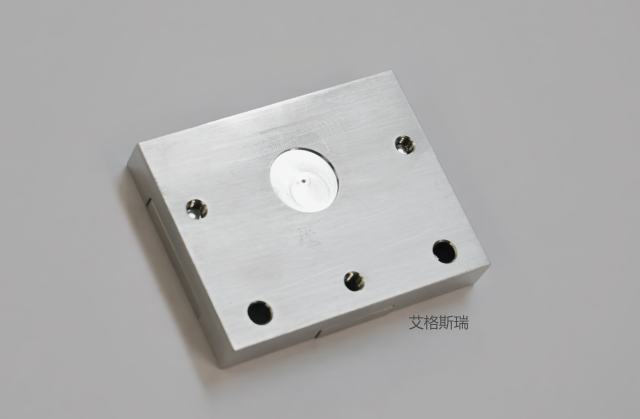
Figure 1 Physical image of the self-developed ultra-high aspect ratio pinhole SpotUH
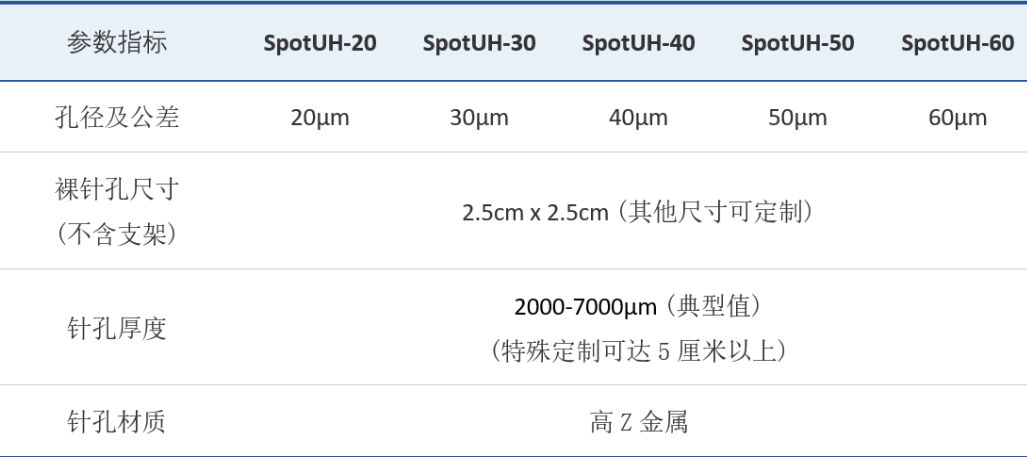
Table 1 Technical specifications of SpotUH pinhole/aperture


Experiment 1: Comparative experiment on high-energy blocking capability of pinholes

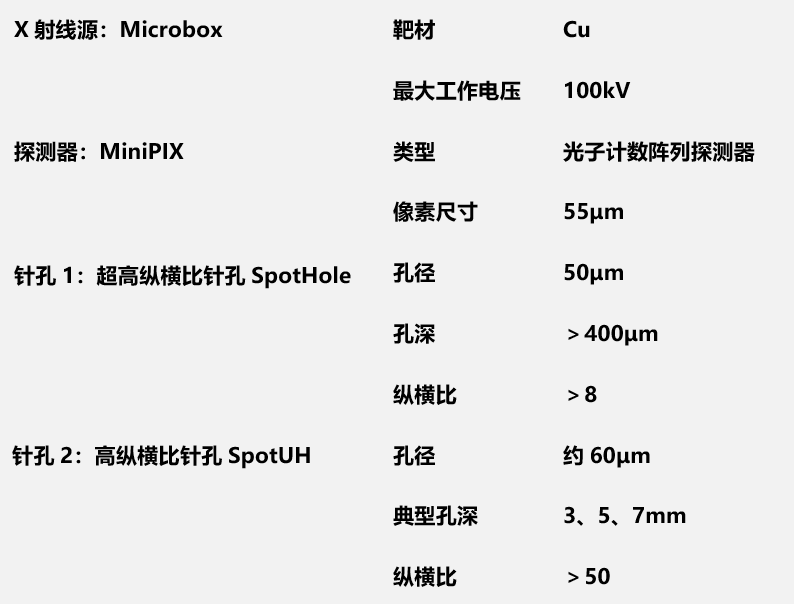
To evaluate the beam-limiting performance and high-energy transmission blocking capability of the self-developed ultra-high aspect ratio pinhole (SpotUH) under different photon energy conditions, we selected it for comparative experiments with a similar commercially available product (SpotHole).
In the experiment, a photon-counting array detector was placed close to the pinhole exit, and the spatial distribution of photons transmitted through the pinhole was obtained by direct imaging. This method can be used to characterize the effective aperture size of the pinhole on the one hand, and to directly reflect its ability to "intercept" photons of different energies on the other.
The operating voltage of the microfocus X-ray source was gradually increased from 50 kV to 100 kV (step 10 kV, 6 energy points in total), and the exposure time at each energy point was fixed at 1 s.
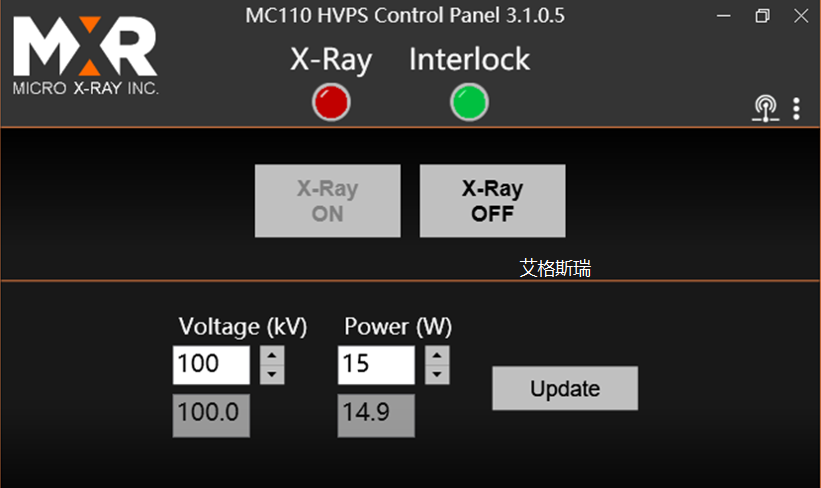
Figure 2 The light source can be loaded up to 100 kV 15 W
Taking the pixel with the maximum signal intensity as the center, an 80×80 pixel region was cropped for comparative analysis, and the results are shown in Figure 3.
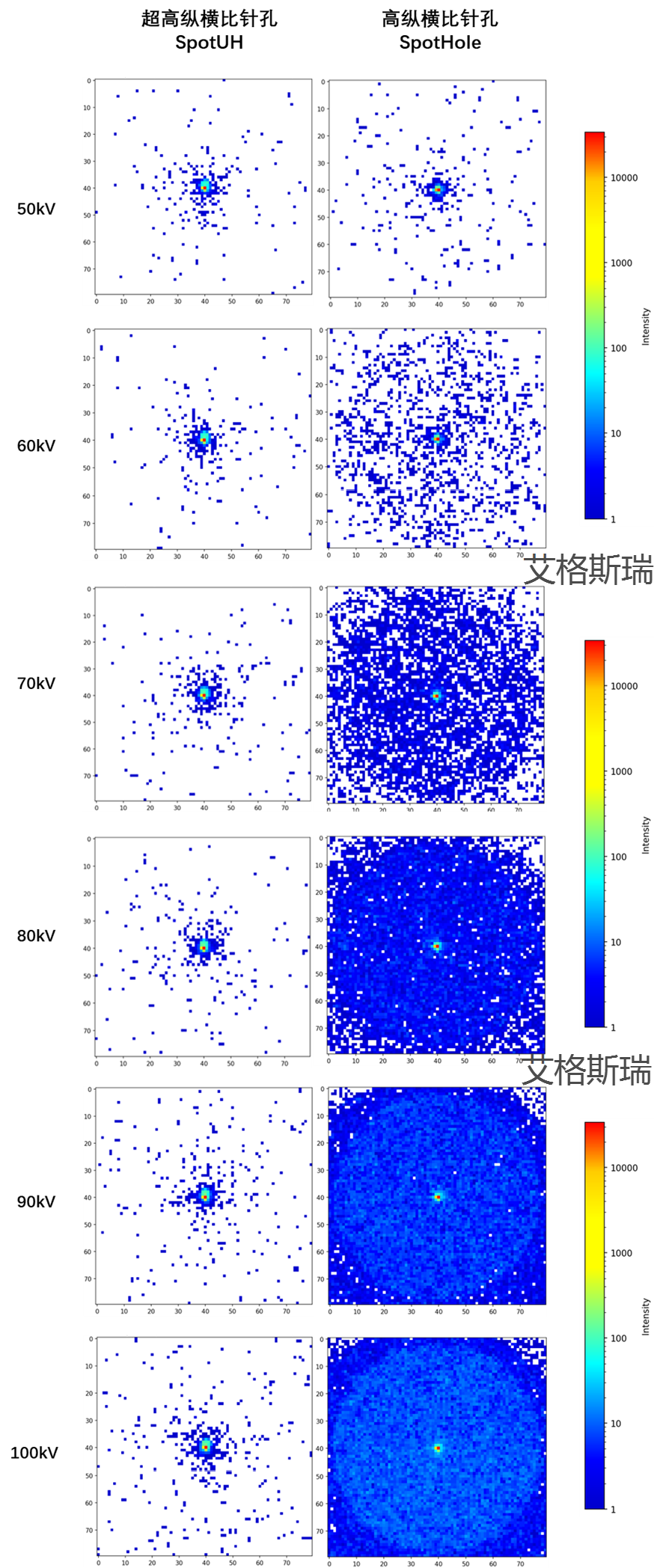
Figure 3 Comparison of photon blocking capability of two pinholes at different operating voltages
(Note: Zoom in on the image to see that the central strong region is only 1 pixel)
From the experimental results, it can be seen that for the SpotHole pinhole, as the operating voltage increases, the blue transmitted photon background count increases significantly. In particular, during the process of raising the tube voltage from 50 kV to 100 kV, the background image gradually transitions from sparse scattered points to a dense image. This indicates that its blocking capability for high-energy photons becomes insufficient as the tube voltage increases, resulting in a high-energy penetration background with single-pixel intensity counts of less than 10. In contrast, SpotUH exhibits significantly fewer high-energy penetration background signals at all energy points, indicating its stronger blocking capability for high-energy photons. Both pinholes have pixels with counts of several tens in the central region, which mainly originate from scattering caused by the pinhole edges.
To quantitatively compare the contributions of scattering and high-energy penetration background, we define the signal-to-background ratio (SBR) of the beam spot after pinhole beam limiting as the ratio of the highest single-pixel count in the limited beam spot to the total count of the surrounding 6399 pixels. The SBR of the two pinholes at different tube voltages is shown in Table 1.
Table 2 Signal-to-background ratio (SBR) of SpotHole and SpotUH at different tube voltages
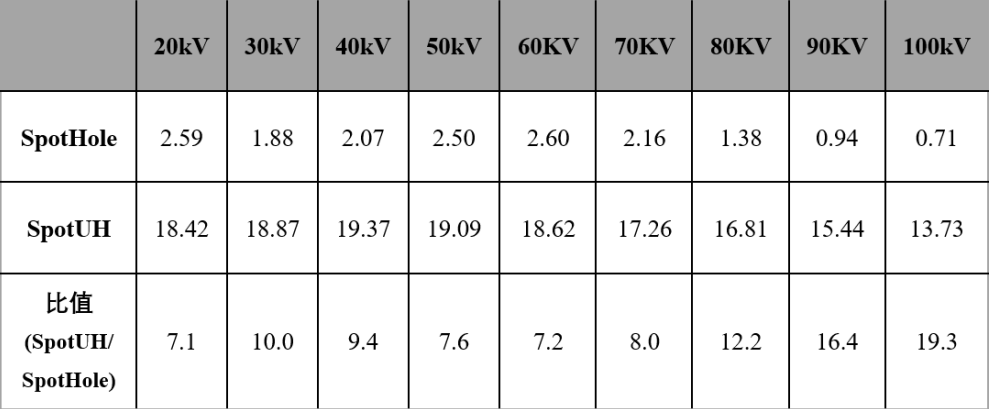
As can be seen from the table above, within the tube voltage range of 20–70 kV, the SBR of SpotUH is nearly an order of magnitude higher than that of SpotHole; after 80 kV, as the tube voltage increases, the gap between the two widens sharply, reaching nearly 20 times at 100 kV.
In addition, the peak intensity region of the imaging beam spot for both pinholes is concentrated in a single pixel (red pixel). Considering that the detector pixel size is 55 μm, the imaging beam spot of the 50 μm aperture SpotHole mainly falls within a single pixel range; the approximately 60 μm aperture SpotUH still maintains a single-pixel dominant distribution under strong beam-limiting conditions, indicating that it does not introduce obvious spatial divergence while achieving high-energy blocking, and the imaging size is consistent with expectations.


Experiment 2: Spectrum measurement with ultra-high aspect ratio pinhole
Comparison with limitations of conventional methods

In the measurement of the original spectrum of an X-ray tube, obtaining the intrinsic spectral distribution unaffected by detector nonlinear effects and external modulation is the basis for subsequent quantitative analysis and spectral modeling.
In this work, the self-developed ultra-high aspect ratio pinhole (SpotUH) was used for spectrum measurement experiments, and the original spectrum of the X-ray tube was directly acquired through pinhole beam limiting. The core of this method is to use spatial beam limiting (reducing the collection solid angle) to effectively reduce the incident light intensity, so that the detector operates in the linear response region, thereby simultaneously suppressing the effects of count saturation and pulse pile-up on spectral measurement. At the same time, this process does not rely on material attenuation filters, and its effect on the spectral shape is negligible, thus preserving the inherent emission characteristics of the X-ray tube to the greatest extent.
To verify the necessity of spectrum acquisition with the ultra-high aspect ratio pinhole, the feasibility of two conventional alternative methods was also examined.
Experimental configuration:
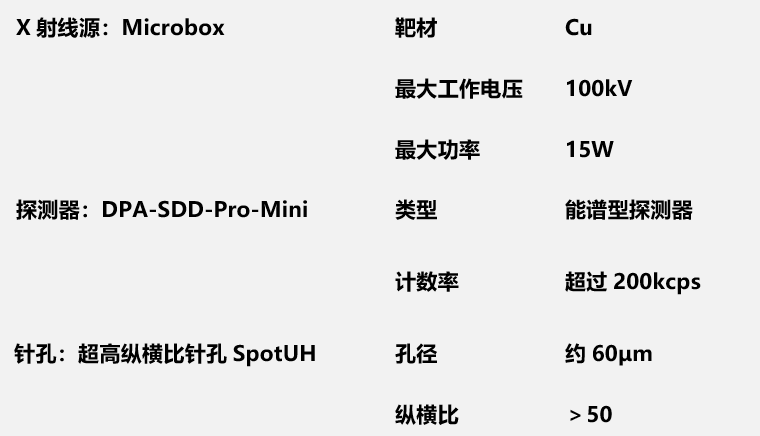
Experimental process & results:
The SDD was placed about 10 cm from the light source, and a 2 mm thick Al filter was added in front of the detector for intensity attenuation. Without introducing significant dead time, the operating power of the light source could only be increased to 20 kV 0.25 mA (5 W). At this time, the low-energy region was severely absorbed, and even the Cu K-line characteristic peak could not be observed. The continuum background was also clearly distorted, indicating that material attenuation caused significant energy-selective distortion of the spectral shape.
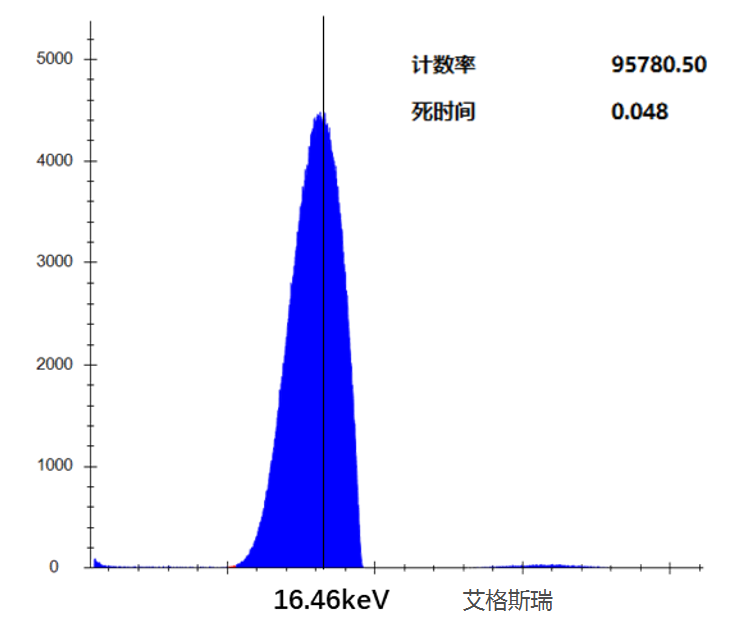
Figure 4 Spectrum after filtering with a 2 mm Al filter (light source: 20 kV 0.25 mA)
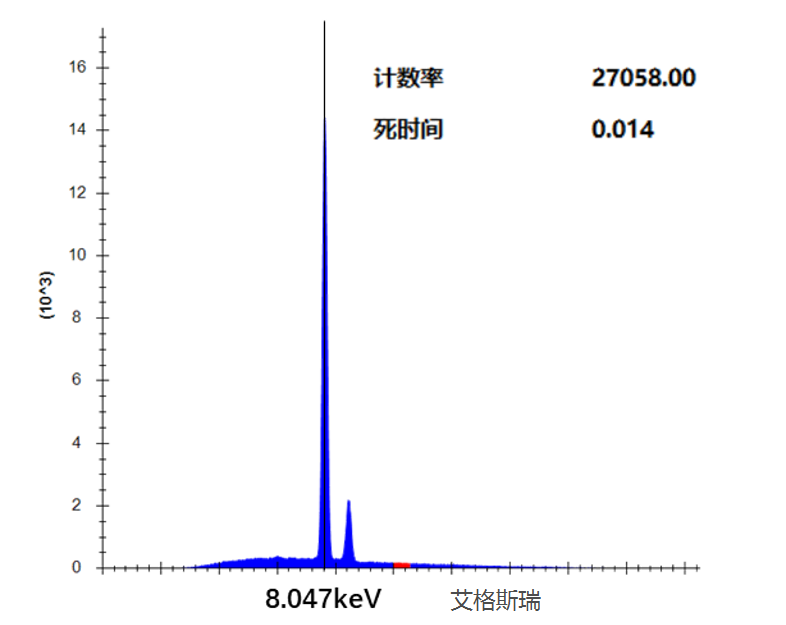
Figure 5 Spectrum after pinhole beam limiting without filter (light source: 20 kV 0.25 mA)
Furthermore, while keeping the optical path structure unchanged, the light source power was increased to 100 kV, 15 W. At this time, the detector dead time only increased to 0.095, still in the low pile-up operating region. The spectral shape did not show obvious distortion, and the characteristic peak positions did not drift.
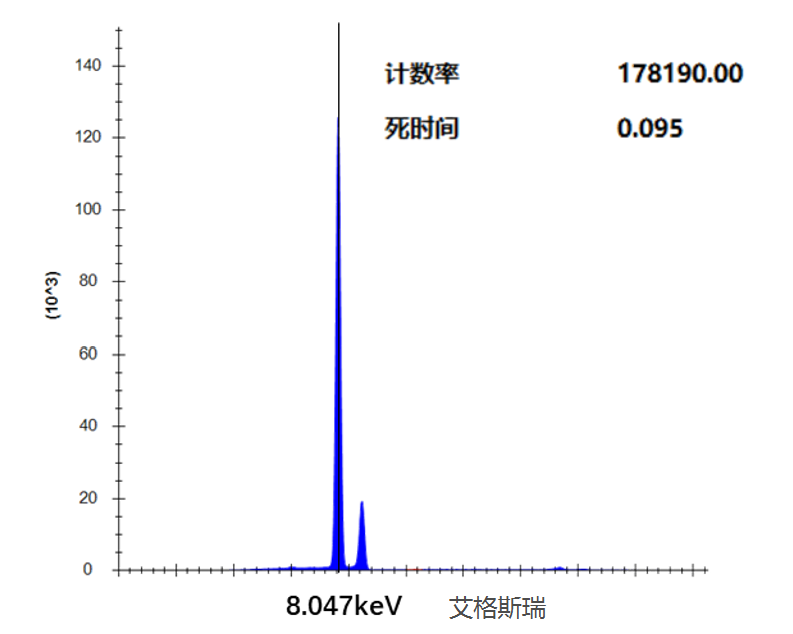
Figure 6 Spectrum after pinhole beam limiting without filter (light source: 100 kV 0.15 mA)
Conclusion:
Although using a filter can reduce the detector load, due to the significant differences in absorption cross-sections of photons at different energies, it causes excessive suppression of the low-energy region, thereby introducing systematic spectral distortion and failing to reflect the true emission characteristics of the X-ray tube. In contrast, using the ultra-high aspect ratio pinhole for spatial beam limiting, even under high-energy full-power conditions (100 kV 15 W) without a filter, can obtain an original spectrum close to the intrinsic emission of the light source.
By increasing the distance between the detector and the light source to reduce the detection solid angle, the incident count rate is lowered to avoid spectral distortion. This method essentially relies on geometric divergence (1/r² attenuation) to achieve flux suppression.
Experimental configuration:
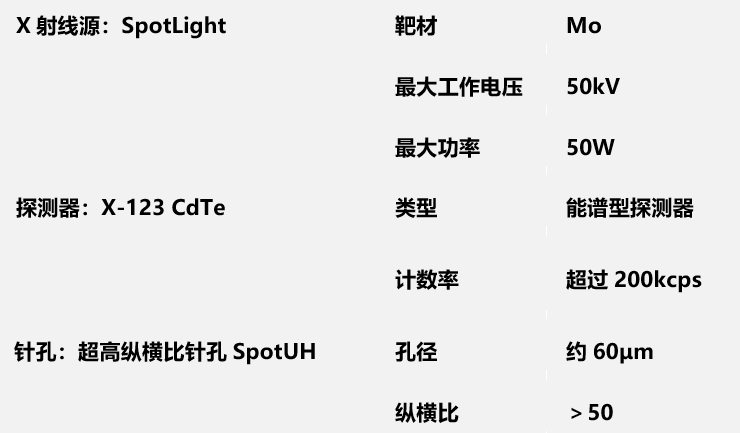
Experimental process & results:
In the actual experiment, limited by the size of the radiation shielding cabinet and optical platform, the spectral detector was placed about 1 m from the light source for measurement. However, even at this distance, to avoid the detector entering high dead time or experiencing obvious pile-up, the operating power of the X-ray tube still had to be limited to a low level of 40 kV, 0.1 mA (4 W), making it difficult to obtain the original emission spectrum under higher power conditions.
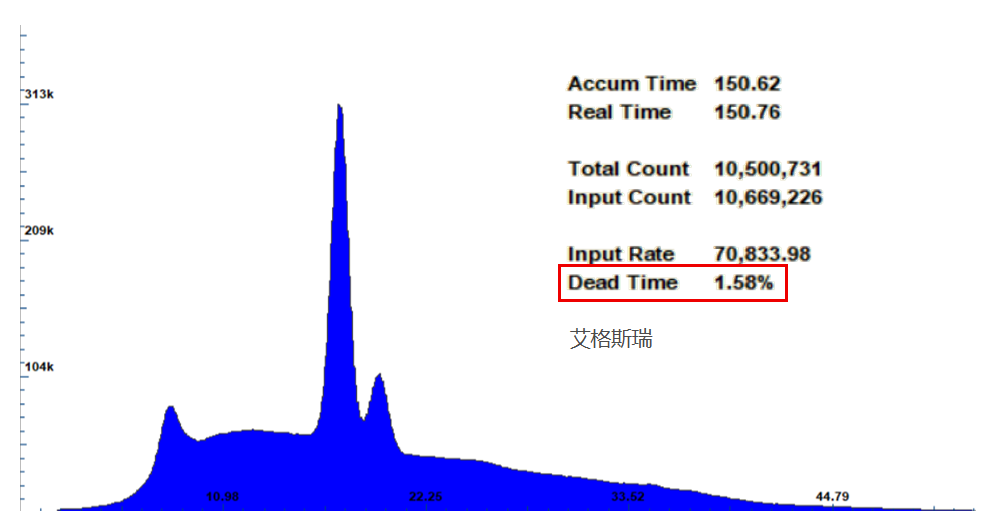
Figure 7 Spectrum without pinhole (light source power: 4 W; light source–detector distance about 1 m)
On the other hand, using the SpotUH pinhole for spatial beam limiting, even with the pinhole placed about 10 cm from the light source and the spectral detector placed close to the pinhole exit (about 4 mm), the system can still operate with almost no dead time under full-power (50 W) conditions of the light source, indicating that the detector still has sufficient count margin.
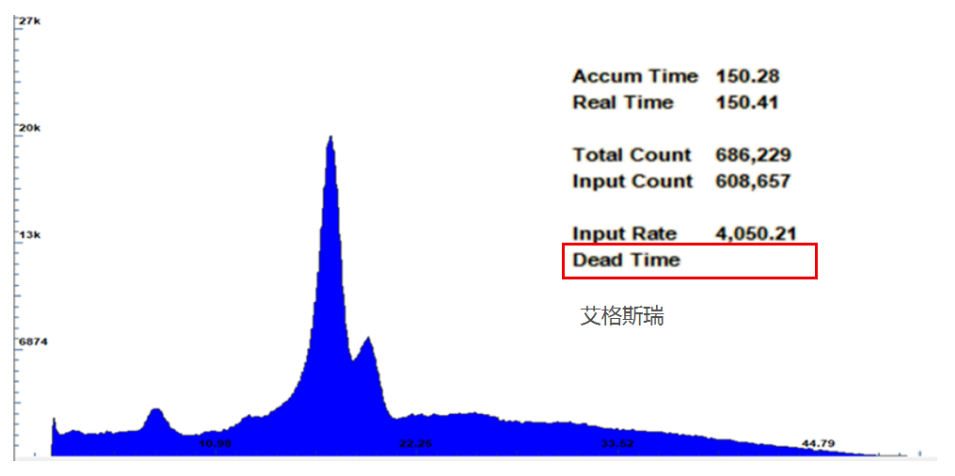
Figure 8 Pinhole spectrum measurement result (light source power: 50 W; light source–detector distance about 10 cm)
Conclusion:
Compared with the geometric attenuation method that relies on distance expansion, long-distance detection has limited flux suppression capability at the laboratory scale and is difficult to support original spectrum measurement under high-power conditions. In contrast, the ultra-high aspect ratio pinhole SpotUH achieves significant compression of the equivalent solid angle through strong spatial beam limiting. Even at close distances, it can obtain true spectra without obvious spectral distortion at high energy and high power.


Summary

This work focuses on the needs of high-energy X-ray photon beam limiting and stable detection, and verifies the key performance and application potential of the self-developed ultra-high aspect ratio pinhole (SpotUH).
Experiments show that compared with conventional high aspect ratio pinholes, SpotUH has stronger high-energy photon blocking capability, can effectively suppress high-energy penetration leakage in the 50–100 kV and even higher energy ranges, and maintains stable spatial beam-limiting characteristics.
This type of pinhole is very suitable for accurate measurement of the original spectrum of X-ray sources, and can also be extended to fields such as high-energy X-ray imaging, focus size and stability measurement of high-energy X-ray sources, and spectral analysis, providing a universal front-end solution for spatial beam limiting under high-energy, high-flux conditions.
If you have related application needs, you are welcome to discuss specific application scenarios with us or participate in trial testing.

Agrius XRAY



Agrius
Focusing on core X-ray components/parts
R&D/design/manufacturing/solutions
www.x-rayvision.com
FROM READING TO APPLICATION
Put this knowledge to work
Need to assess product suitability, discuss experimental conditions or find technical support? Explore our products and services, or discuss this resource with us.