
Energy-Dispersive X-ray Fluorescence (EDXRF)
Energy dispersive X-ray fluorescence (EDXRF) is one of the two general types of X-ray fluorescence techniques used for elemental analysis applications. In an EDXRF spectrometer, all elements in the sample are excited simultaneously, and an energy dispersive detector combined with a multichannel analyzer is used to simultaneously collect the fluorescent radiation emitted from the sample and then distinguish the different energies of the characteristic radiation from the individual sample elements. The resolution of an EDXRF system depends on the detector and typically ranges from 150 eV to 600 eV. The main advantages of EDXRF systems are simplicity, speed, no moving parts, and high source efficiency.
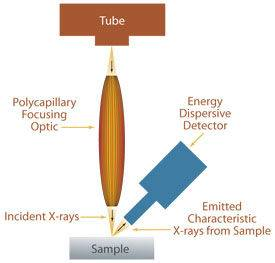
X-ray optics can be used to enhance EDXRF instruments. For conventional XRF instruments, the typical focal spot size on the sample surface ranges in diameter from a few hundred micrometers to several millimeters. Polycapillary focusing optics collect X-rays from a divergent X-ray source and guide them to form a small focused beam on the sample surface with a diameter as small as a few tens of micrometers. The resulting increased intensity delivered to the sample in a small focal spot can enhance the spatial resolution for small-feature analysis and the trace element measurement performance for micro-EDXRF applications.
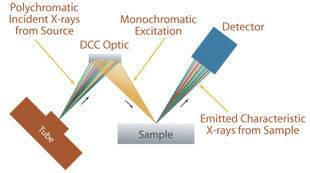
Doubly curved crystal optics guide a high-intensity micrometer-scale monochromatic X-ray beam onto the sample surface to improve elemental analysis capability.
FROM READING TO APPLICATION
Put this knowledge to work
Need to assess product suitability, discuss experimental conditions or find technical support? Explore our products and services, or discuss this resource with us.