
Micro X-ray Fluorescence (µXRF)
Micro X-ray fluorescence (µXRF) is an elemental analysis technique that allows the detection of very small sample areas. Like conventional XRF instruments, micro X-ray fluorescence uses direct X-ray excitation to induce characteristic X-ray fluorescence emission from the sample for elemental analysis. Unlike conventional XRF, whose typical spatial resolution ranges from a few hundred micrometers to a few millimeters in diameter, µXRF uses X-ray optics to limit the excitation beam size or focus the excitation beam onto the sample surface to form a small spot, thereby enabling the analysis of small features on the sample. Conventional µXRF instruments use a simple pinhole aperture to limit the incident beam size on the sample surface. Only X-rays coaxial with the hole are emitted from the aperture. Unfortunately, this method blocks most of the X-ray flux emitted by the X-ray source, resulting in low incident flux on the sample, which affects the sensitivity of the method for analyzing trace elements.
Polycapillary and doubly curved crystal focusing X-ray optics provide an alternative method for µXRF applications to form a small focal spot with high X-ray flux on the sample surface. In addition, these optics overcome the limitation imposed by the inverse-square dependence of X-ray intensity on distance from the source, thereby enabling the development of small-footprint and low-power µXRF systems for the in-line semiconductor and other materials industries, as well as remote or portable instruments. µXRF using X-ray optics has been successfully used in a variety of applications, including small feature evaluation, elemental mapping, thin film and coating thickness measurement, trace contaminant detection, multilayer coating evaluation for advanced circuit boards, particle analysis and forensics.
Polycapillary focusing optics collect X-rays from a divergent X-ray source and guide them to form a small focused beam with a diameter as small as a few tens of micrometers on the sample surface. Compared with using a simple pinhole collimator, the resulting increased intensity delivered to the sample in a small focal spot enhances the spatial resolution and trace element measurement performance for small feature analysis.
Doubly curved crystal optics guide a high-intensity micrometer-scale monochromatic X-ray beam onto the sample surface to enhance elemental analysis. Monochromatic excitation eliminates the X-ray scattering background beneath the fluorescence peaks, resulting in higher measurement sensitivity than µXRF methods using a pinhole.
µXRF technology can be implemented using polycapillary or doubly curved crystal optics with an EDXRF or WDXRF configuration.
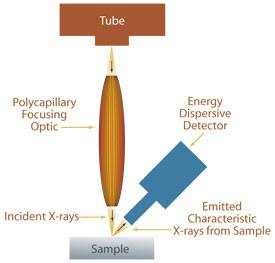
Standard µXRF configuration. The sample can be scanned to measure the elemental distribution within the sample with a spatial resolution as small as 10 µm (varying with energy).
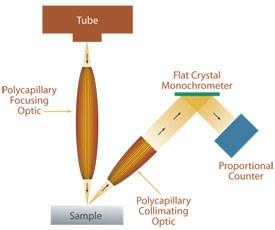
Micro WDXRF instruments use polycapillary focusing optics to focus X-rays from the source onto the sample, and use polycapillary collimating optics to collect the fluorescence emitted from a small spot on the sample surface and direct it onto a dispersive crystal.
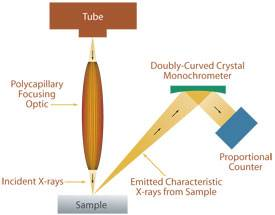
Micro WDXRF uses polycapillary focusing optics to focus X-rays from the source onto the sample, and uses a doubly curved crystal monochromator to collect and disperse the fluorescent X-rays emitted from a small spot on the sample and direct them to the detector.
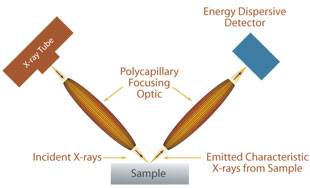
Confocal µXRF uses two polycapillary optics, one for small-spot sample excitation and the other as a spatial filter, and is suitable for all applications in which background radiation originates from regions that do not interfere with the signal of interest. This configuration is suitable for measuring spatial distributions in radioactive samples and for depth-profiling applications.
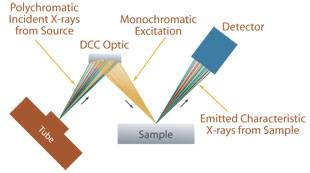
Monochromatic micro EDXRF using doubly curved crystal optics.
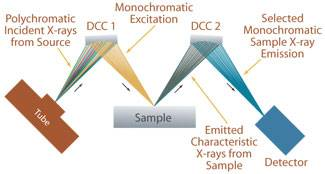
Monochromatic WDXRF using doubly curved crystal optics offers very high sensitivity for the specific sample elements of interest. This technique has been successfully applied to the determination of low sulfur content in petroleum products.
FROM READING TO APPLICATION
Put this knowledge to work
Need to assess product suitability, discuss experimental conditions or find technical support? Explore our products and services, or discuss this resource with us.