
High-Definition X-ray Fluorescence (HDXRF)
An introduction to HDXRF, DCC optics and monochromatic excitation for rapid, nondestructive elemental analysis of consumer products.
Advantages of High-Definition X-ray Fluorescence (HDXRF)
XOS applies HDXRF to the rapid detection of regulated elements in toys and consumer products. This elemental analysis technology is intended to help manufacturers and regulators address public-health concerns by combining rapid testing with accurate measurements.
Advantages of HDXRF
Rapid results: Faster measurements allow more toys to be inspected. The source describes measurement speeds more than 100 times faster than conventional analytical techniques.
Accuracy: Low detection limits support reliable results and reduce the likelihood of false-positive findings.
Small spot: A region approximately 1 mm in diameter can be examined without sacrificing speed or data quality.
Ease of use: A large sample chamber and minimal sample preparation allow a wide range of products to be measured.
Nondestructive testing: Products can return to the production line, store shelf or consumer after testing.
Versatility: The source describes applications ranging from objects as small as a grain of sand to products as large as a school bus.
Use beyond the laboratory: The system can support testing in manufacturing facilities, distribution centers and retail locations, from the point of origin to the end user.
What Is HDXRF?
HDXRF is an elemental analysis technique that uses doubly curved crystal (DCC) optics to collect X-rays from a divergent source and redirect them into an intense focused beam on the product surface. The configuration below illustrates HDXRF measurement of lead in consumer products.
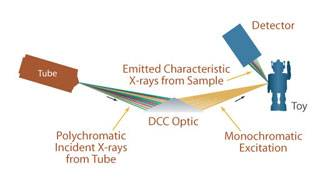
HDXRF uses DCC optics to measure toxic metals in consumer products.
A key advantage of HDXRF is monochromatic excitation, which suppresses the scattered X-ray background beneath fluorescence peaks and substantially improves detection performance. According to the source, detection limits for many elements of interest in a range of materials can reach the parts-per-billion (ppb) level. The following comparison shows one-second measurements of lead in a toy.
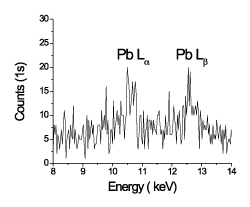
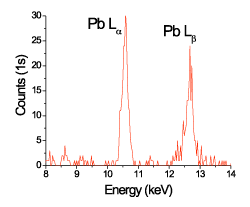
Measurements of an actual plastic toy using conventional XRF (left) and HDXRF (right). The lead (Pb) peak is barely visible in the conventional XRF result. Suppression of the background in HDXRF makes the lead signal readily detectable.
Source: XOS website.
FROM READING TO APPLICATION
Put this knowledge to work
Need to assess product suitability, discuss experimental conditions or find technical support? Explore our products and services, or discuss this resource with us.