
Confocal X-ray Fluorescence
Confocal XRF uses two polycapillary focusing optics to measure elemental composition within a small sampling volume, supporting depth profiling and microanalysis.
XRF Applications: Confocal X-ray Fluorescence
Confocal geometry uses two polycapillary focusing optics to enhance XRF elemental analysis. The excitation optic focuses a small X-ray beam onto the sample, while the detection optic collects fluorescent X-rays from the sample. Elemental concentrations are measured within a small sampling region, known as the confocal volume, defined by the intersection of the output focal spot of the excitation optic and the input focal spot of the collection optic.
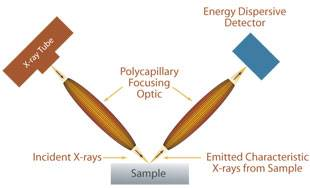
This method can be used to detect and quantify elements in radioactive materials. The polycapillary focusing optics act as spatial filters to suppress background radiation from the sample and improve sensitivity to the elements of interest. Confocal XRF can also be used for elemental depth profiling. When the confocal volume lies within the sample, characteristic X-ray photons excited and emitted within that volume are detected for material analysis. In this way, elemental concentrations can be measured at the surface and at different depths within an object. Confocal X-ray fluorescence with X-ray optics has been applied to thin-film thickness measurement, forensics, art restoration and microanalysis.
Source: XOS website.
FROM READING TO APPLICATION
Put this knowledge to work
Need to assess product suitability, discuss experimental conditions or find technical support? Explore our products and services, or discuss this resource with us.