

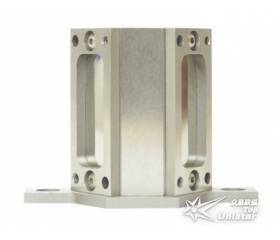
Hyperbolic X-ray Curved Crystal - XRD/XRF
Using a doubly curved crystal (DCC) provides three-dimensionally focused, highly monochromatic X-rays.

Introduction
Using doubly curved crystals (DCC), three-dimensionally focused, highly monochromatic X-rays can be obtained. Crystal materials such as mica, graphite, silicon, and germanium are applicable in the energy range of 1.5-58 keV. These crystals reflect X-rays based on Bragg's law of diffraction.

Company introduction:
XOS, based in the United States, is a world-renowned company providing specialized complete X-ray analytical instruments. The company offers elemental analysis solutions to enhance public safety and customer efficiency in the petroleum, consumer products, and environmental assessment industries. Its products include X-ray fluorescence analysis equipment for various applications, as well as high-end X-ray components such as bright microfocus X-ray sources, polycapillary X-ray lenses, and doubly curved crystal focusing optics.
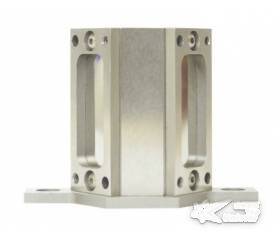
Features & Advantages
Specifications
| Table 1: Typical performance parameters of DCC crystals | ||||
| Element | Foucusing B (keV) | Focal Length (mm) | Collection Solid Angle (sr.) | Focusing Spot (μm) |
| Cr | 5.4 | ≥ 100 | ≤ 0.015 | 200 |
| Cu | 8 | ≥ 100 | ≤ 0.004 | 100 |
| Mo | 17.5 | ≥ 120 | ≤ 0.001 | 100 |
| Rh | 20.2 | ≥ 150 | ≤ 0.001 | 150 |
Typical applications
- Monochromatic XRF
- Single-crystal XRD
- Powder XRD
- Microanalysis
- X-ray reflection (Metrology)
- Provides a better P/B ratio for X-ray imaging, improving contrast for medical imaging applications
- Wavelength dispersive spectrometer (WDS)